Find an answer

Search SANPEC

Popular: Testing & Validation · SunZia · Technical Papers

SANPEC

Navigate

Engineering for the grid ahead.

Business excellence framework

The Six Pillars and a 365 model of learning.

SANPEC’s source materials use six connected strategic advantages and a Create → Measure → Transfer → Recreate loop to frame performance, learning, and infrastructure value.

The 365 Model

Every project should make the next project stronger.

The source-site 365 Model is a knowledge cycle designed for volatile, uncertain, complex, and ambiguous operating conditions. It turns engineering work, testing, source inspection, root-cause analysis, and project feedback into a compounding institutional capability.
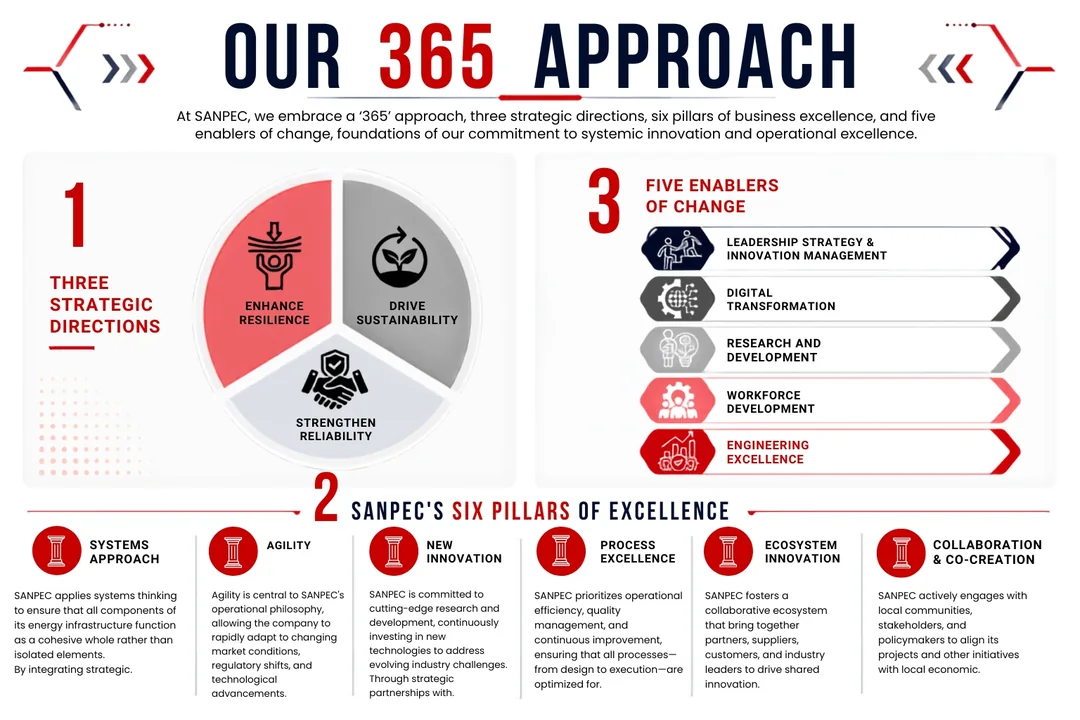
  • Create new knowledge, solutions, and field-grounded insight.
  • Measure quality, reliability, resilience, and corrective-learning signals.
  • Transfer validated lessons across teams, suppliers, and programs.
  • Recreate improved standards in the next context.
SANPEC 365 approach source infographicLearning as infrastructure

The Six Pillars

A framework made useful in the work.

The legacy content is extensive and repetitive. The redesigned version gives each pillar a concise, decision-oriented explanation while retaining the source intent.

01 · Systems Approach & Foresight

See the interdependencies between engineering, manufacturing, quality, delivery, and long-term grid performance.

  • Integrate components and interdependencies rather than optimizing functions in isolation.
  • Use feedback loops and real-time information to adapt decisions across the program.
  • Connect research, engineering, manufacturing, quality, and delivery to shared strategic outcomes.
02 · Agility & Strategic Planning

Adapt structured delivery to changing constraints, information, demand, and risk.

  • Respond to changing conditions, client requirements, and delivery constraints with structured flexibility.
  • Support cross-functional collaboration and scalable execution.
  • Plan for uncertainty rather than treating disruption as an exception.
03 · New Solutions & Innovation Management

Convert research, learning, and emerging technology into more capable infrastructure decisions.

  • Create a pathway from research and technical learning to better engineering and process decisions.
  • Use structured innovation management and validation, not novelty for its own sake.
  • Keep future infrastructure requirements in view while resolving current constraints.
04 · Process Excellence

Use disciplined workflows, quality systems, measurement, and continuous improvement.

  • Use disciplined workflows, quality management, measurement, and corrective learning.
  • Reduce avoidable handoff loss across design, sourcing, inspection, logistics, and construction.
  • Support consistent outcomes and continuous improvement.
05 · Ecosystem Innovation

Build useful collaboration across suppliers, partners, customers, researchers, and industry.

  • Work with suppliers, partners, customers, research institutions, and industry stakeholders.
  • Use collaboration to strengthen visibility, ideas, material decisions, and delivery readiness.
  • Treat sustainable supply-chain and value-chain relationships as engineering-relevant.
06 · Collaboration & Co-Creation

Create shared value with stakeholders, communities, education partners, and the wider value chain.

  • Co-create with broader stakeholders and community partners where infrastructure outcomes intersect.
  • Support knowledge sharing, education, workforce development, and local capability.
  • Build shared value beyond a single project transaction.

Use it in context

From a business-model statement to a project conversation.

01

Frame the system

Identify the engineering, quality, material, schedule, stakeholder, and resilience interdependencies.

02

Make evidence visible

Bring inspection, test, delivery, risk, and performance information into the right decision cycle.

03

Coordinate the ecosystem

Align design, vendors, suppliers, logistics, construction, research, and community needs where relevant.

04

Learn forward

Capture valid lessons and improve the next component, process, project, or standard.

05

Build lasting value

Keep safety, quality, reliability, resilience, sustainability, and stakeholder value in view together.

Connect with SANPEC

Use a systems-led approach to clarify the next engineering decision.

Discuss a project